1. Move in Closer.
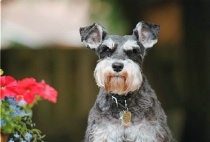
Each time you spot a subject, snap a shot and then move in closer for a better shot.
Having your subject almost fill the frame helps your viewer understand and appreciate
your photo. Also, details are often more interesting than an overall view
Keep moving in closer until you are sure a 4 x 6 photo will successfully represent
your subject. At the same time, it is a good idea to keep your distance from wild
animals and the like; balance boldness with consideration and wisdom.
2. Be Quick
If it is at all possible that your subject may fly away, stop smiling, bolt, or
just get tired of waiting for you to take the picture, shoot once right away. Practice
getting quicker and quicker to the draw. Do not worry so much about taking "too
many" pictures and do not wait until you're absolutely certain all the knobs and
buttons are in their correct position.
For a great example of the rewards that can be attained by being able to work quickly,
check out how Ansel Adams got "Moonrise, Hernandez,
New Mexico."
3. Compose Your Picture with Care
Even if you don't plan on selling your photo to the Smithsonian, make an effort
to keep it balanced and beautiful; on one level or another, everyone responds better
to a picture that has all elements in balance or that leads the eye along an interesting
path through the photo.
For starters:
- Keep the horizon level;
- Crop out extra elements that you are not interested in (more on this is the next
tip);
- Consciously place your subject where you think it most belongs rather than just
accepting it wherever it happens to land in the photo;
- Play with perspective so that all lines show a pattern or lead the eye to your main
subject;
- Work with the Rule of Thirds.
4. Be Selective
Discern what you are really interested in and center your efforts on getting the
best photo of this subject, whether it is an animal, person, mood, culture, etc.
Along these lines, be sure to keep anything that would distract out of the picture.
You may not want to go as far as Ansel Adams did
to remove unwanted elements, but you must be aware of the problem. The easiest way
to do this is to watch your borders and recompose if something - such as an unattractive
telephone wire, an old soda can, a distracting sign, or your finger - hangs into
your picture. It becomes a bit more difficult and frustrating if you want to, say,
shoot a San Francisco cable car without a single telephone line in the picture.
Even in such a difficult case, though, you have many options. You can:
- Focus in on a close-up that tells the whole story;
- Move around until you manage to get the telephone lines (or whatever) to make a
neat pattern that leads to the subject; or
- Take a panning shot so that, if you're successful, the cable car remains in focus
while the background goes blurry.
5. Focus on your Subject
Practice shooting with different apertures and monitor the results from the lab
to learn how depth-of-field effects your photo. You will find that a smaller depth-of-field
(and smaller f-stop #) focuses all the attention upon your subject. This is great
for taking a picture of your child, your dog, or your husband; subjects stand out
against a blurry background. Likewise, you will find that a greater depth-of-field
(bigger f-stop number) will make everything from here to eternity appear in focus.
This will help make those landscapes fascinating and lovely to look at.
6. Experiment with Shutter Speed
One of the most basic, overlooked, and fun aspects of photography is that you have
the power to slow time down or catch a split second. One image happens so slowly
that we could never see it and the other happens so quickly in real time that we
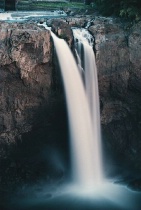
would never notice it. Play with shutter speed! Use a slow shutter speed and a tripod
to make a pretty picture of any creek or stream. On the other hand, you can use
a fast shutter speed (1/500 and up) to capture an object in motion. Combining a
fast shutter speed with a long lens, you sports buffs can get a trophy of your own
when you are able to catch the expression on your favorite runningback's face as
he slips past the final defense toward a winning touchdown. Remember, catching the
moment in fast-paced action photography may take a little more practice so - hang
in there.
7. Look at the Light
By this, I don't mean look into the sun; that won't do at all. But it is good to
see what kind of light you are working with. Which way are the shadows falling?
Unless you want a silhouette effect, where your subject is black against an interesting
background, it's generally best to shoot with the sun behind you. How is the light
affecting your subject? Is the subject squinting?
Is the light blazing bright upon your whole subject? This works well if you are
in love with the bold colors of your subject. Side lighting, on the other hand,
can add drama but can also cause extreme, hard-to-print contrasts. Lastly, indirect
light to make your subject glow soft and pretty.
8. Watch the Weather, Too
Look outside and decide whether or not you are going to want to have the sky in
your picture. If it's overcast, simply keep the sky out of your pictures as much
as possible. This is usually the best way to avoid both muted tones in your subject
and washed-out skies in your background. You might also find black and white pictures
of an overcast day more pleasing than color.
When the day is beautiful, go ahead and make the most of it. If your camera allows
for the use of filters, purchase a polarizer. This will help you render deep blue
skies against bright white clouds, richly contrasting colors, and other wonderful
effects with a simple twist of the wrist.
9. Keep Your Camera Setting Simple
While you may wish to have "all the bells and whistles" available just in case,
you will probably get the best results if you do not try to use them all the time
and instead learn a simple set up that works best for you in most situations. This
doesn't necessarily mean keeping your camera set on program; while this mode may
be perfect in its simplicity, it may be frustrating in its tyrannical control. Instead
of relying on a fully automatic program, pick a simple, semi-automatic program such
as aperture-priority and master shooting in that mode. Then, you'll be able to control
certain basics without letting the other basics control you, and thus keep that
150 page manual where it belongs - in your camera bag.
Tip: if you want one accessory, bring a tripod.
This one item can solve camera shake issues and help you get beautiful evening shots.
10. Be Bold
Do not allow yourself to be paralyzed by fears of using the wrong settings, or an
non-politically-correct social policy. If you are afraid of upsetting someone by
taking their picture, just go up and ask if it's okay. Ask them to sign a release
and offer a print in return. With wildlife, adopt a low-impact method when you go
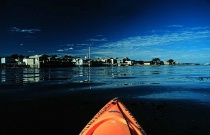
places where few photographers have gone before. In this photo, I put my camera
and telephoto in a waterproof bag and kayaked out into the Monterey Bay. (This can
be dangerous for you, your camera, and the otters - so be careful.) The telephoto
lens allowed me to keep a distance from the otters and still get the image I wanted.
Again, be wise... but be bold.
There you have it - basic but helpful, I hope. Now go out there, make some great
shots, learn from the failures, and have fun.
The tip index
Photo FAQs
|